A Land Record Is Where the Investigation Begins
What page five of a Hidalgo County report led me to ask about work, public funding, and local independence.
I began this work in Texas because it is home.
Foreign interests in agricultural land raise questions that deserve careful investigation. But when I put together a nine-page AFIDA Watch report on Hidalgo County, one page led me toward a broader question about the community itself.
1. The national-security frame
This is no longer only a local question. In February 2025, the America First Investment Policy directed tighter scrutiny of foreign investment in American assets. That July, the Secretary of Agriculture stood with the Secretary of Defense, the Secretary of Homeland Security, and the Attorney General to launch a National Farm Security Action Plan. Its premise was stated plainly: farm security is national security. The federal government has formally placed foreign interests in agricultural land inside the national-security frame. What follows in this newsletter is what that frame looks like from one county's records.
2. How much land, and by whom
Start with the scale of what the records show in Hidalgo County today. The FY2024 filings report 221,562.77 acres of foreign-linked land interests, across 579 filing records and 301 source Owner IDs across 26 country/source codes. Three countries account for nearly three-quarters of it. Mexico reports 69,817 acres — 31.5 percent of the county total. The United Arab Emirates reports 68,134 acres, reported under three source Owner IDs. Portugal reports 26,305 acres, reported under one source Owner ID. Behind them: the United Kingdom (15,365 acres), Bermuda (7,749), Australia (6,474), Germany (5,080), and Switzerland (4,496). And each parcel carries its reported use: across the county, 47.3 percent of the reported acreage is pasture and 43.1 percent is cropland.
3. The time frames
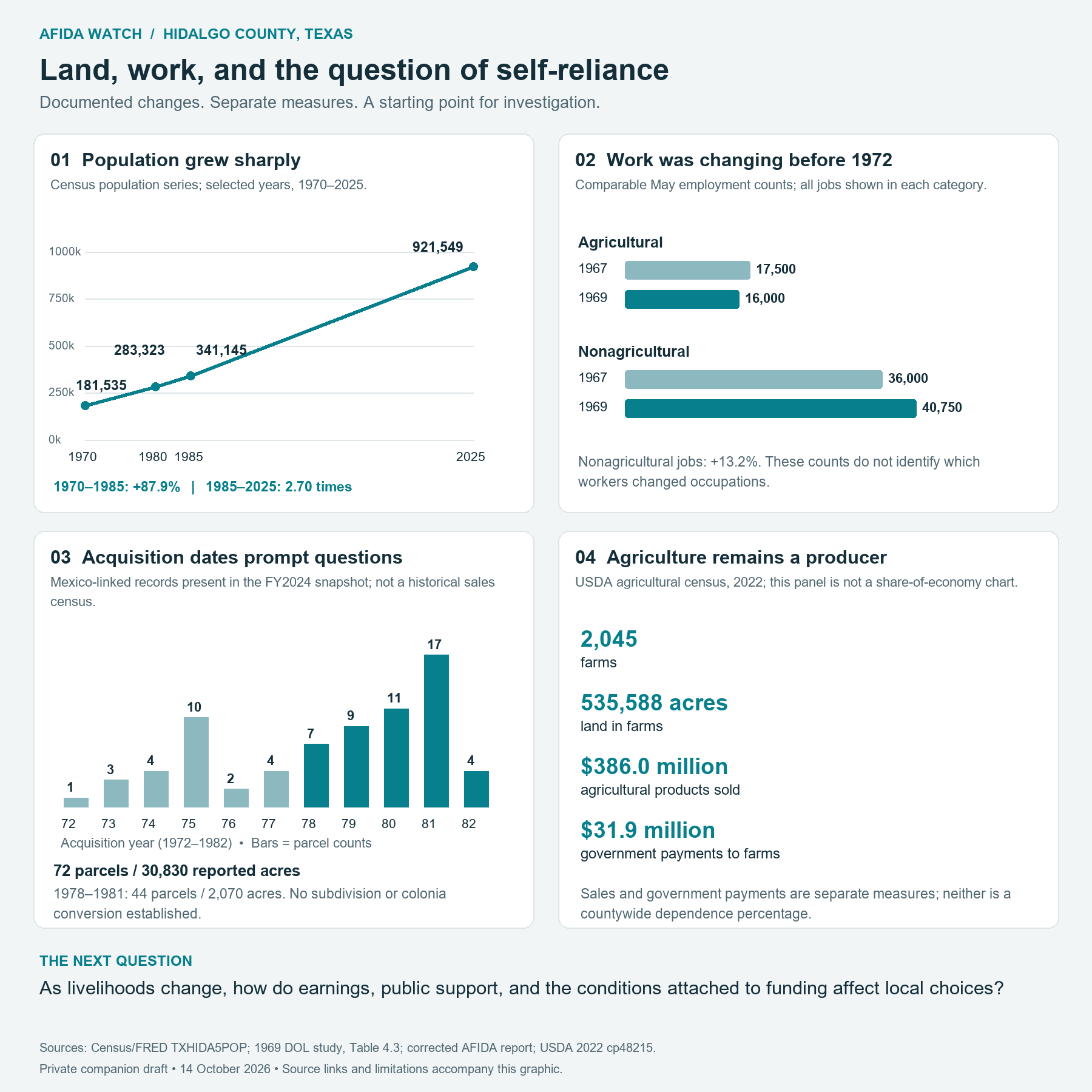
These interests were not acquired all at once, and they were not acquired yesterday. The reported acquisition years in the Mexico records alone run from 1911 to 2009. The movement came in waves. Between 1972 and 1984, the FY2024 snapshot contains at least 236 parcel records with acquisition years in that window, associated with five country codes. Their reported years cluster in sequence: Germany first, in 1972–74; then Mexico, building through 1975 and peaking in 1981 with 17 parcels in a single year; Liechtenstein and Switzerland alongside it, 1976–81; then France, 1980–82. The Mexico wave by itself — 72 parcels between 1972 and 1982 — accounts for 30,830 acres. The filings also record how these interests came: cash purchases, installment purchases, gifts and inheritances, foreclosure, and trade. Two single acquisitions dwarf everything around them: one parcel of 36,357 acres reported in 1941, and one of 27,290 acres in 1976.
4. Who the Owner IDs are
Every one of these records is keyed to an Owner ID — the identifier the reporting system assigns to a holder, and the thread that ties a holder's parcels together across the county. Roll the Mexico records up by Owner ID and the structure appears. Owner 3823 — McAllen de Chapa, Mildred — holds the 1941 parcel: 36,357 acres, acquired by gift or inheritance. Owner 3822 — Alonso, Juan, Mary & Pedro — holds the 1976 parcel: 27,290 acres. Two Owner IDs together account for 91 percent of all Mexico-linked acreage in the county. The pattern repeats at the other end of the table: Portugal's entire 26,305 acres sit under a single Owner ID, 27303 — Hidalgo Wind Farm LLC, 19 parcels. And the opposite pattern exists too: Germany's 5,080 acres are scattered across 96 different Owner IDs, most of them small holders, several holding life estates recorded in the early 1970s. Concentration and dispersal, visible in the same county, in the same set of codes.
I wanted to know: what was happening to Hidalgo County when those interests were being acquired?
Those dates are a starting point. They are not a complete history of land transactions, and they do not explain an owner's intentions. The investigation begins when we place the records beside the history of the people who lived and worked there.
5. The county that was changing
The first finding was striking. A 1973 General Accounting Office report, drawing on fieldwork conducted in 1971, described a county cultivating more land while needing substantially fewer seasonal farmworkers.
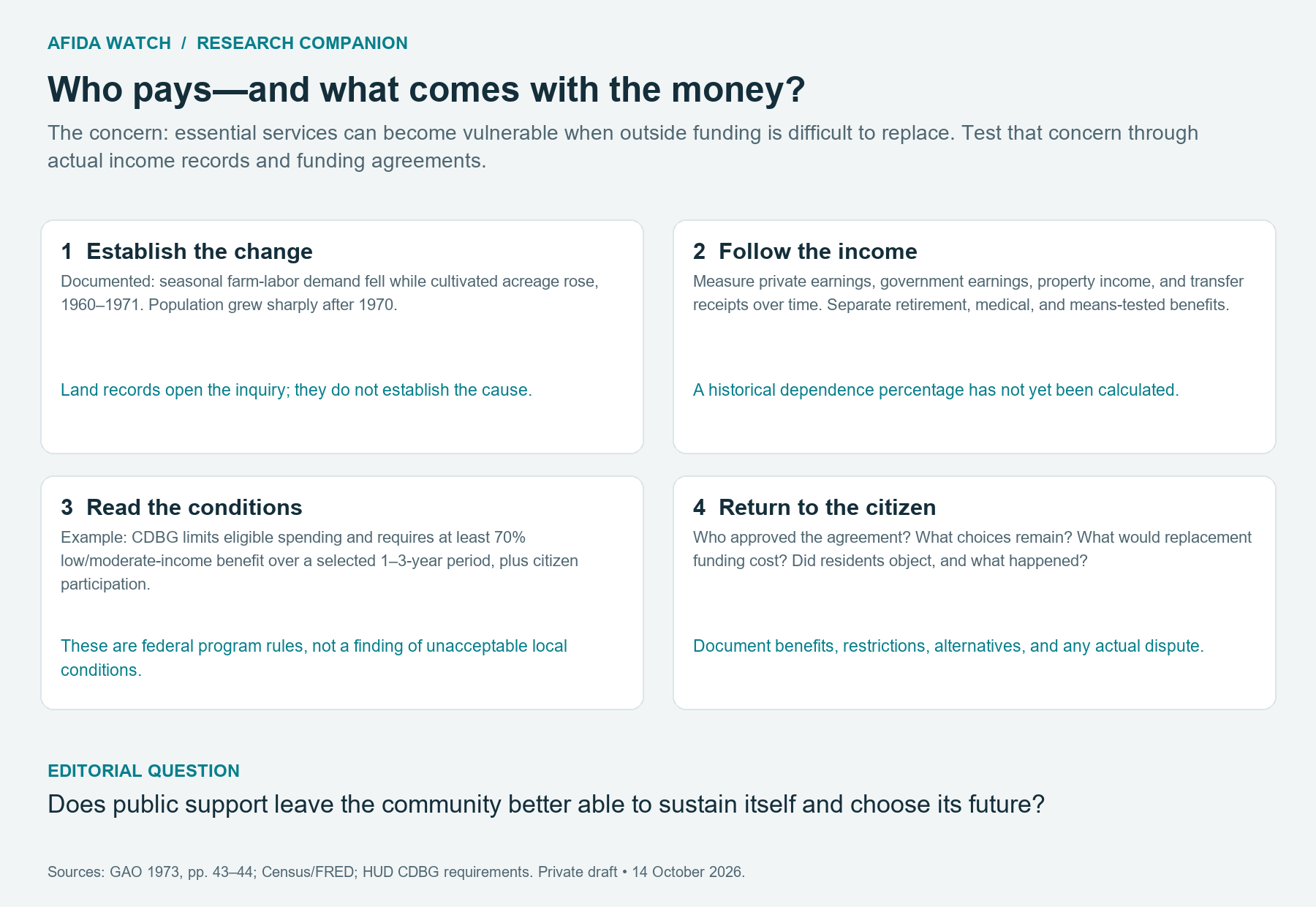
Between 1960 and 1971, cultivated crop acreage increased from approximately 375,000 to 450,000 acres. Estimated demand for migrant and seasonal farmworkers fell from 26,000 to 10,000. Investigators identified mechanization, herbicide use, and difficulty moving into other occupations as important factors. [1]
More cultivated acreage did not mean more opportunities for the families who depended on seasonal agricultural work.
Other work was expanding. A contemporary employment table shows nonagricultural jobs increasing from 36,000 in May 1967 to 40,750 in May 1969. It does not tell us whether displaced farmworkers obtained those jobs. [2]
Then population grew sharply: from approximately 181,535 in 1970 to 341,145 in 1985, an increase of about 88%. The Census series estimates 921,549 residents in 2025. [3]
When a community's established livelihoods change, what replaces the income—and how much freedom does the community retain over its future?
6. What replaced the income
My concern is that families and local institutions can become vulnerable when essential support depends on funding they cannot readily replace. Outside assistance may meet urgent needs and build lasting capacity. It also comes with eligibility rules, spending restrictions, and decisions made beyond the county.
We should examine those arrangements rather than assume every program has the same effect.
Agriculture belongs in that examination too. USDA's 2022 census recorded approximately $386 million in Hidalgo agricultural product sales and $31.9 million in government payments to farms. The county remains a substantial producer. Public support reaches producers as well as households. [4]
The funding question is already concrete. Hidalgo County's 2024 single audit recorded approximately $161.4 million in federal award expenditures and $13.0 million in state award expenditures, excluding separately listed local contributions. These figures cover audited award programs; they are not the county's entire budget or all public spending within its borders. [5]
Conditions are concrete as well. Under HUD's Community Development Block Grant program, eligible spending is restricted, at least 70% of funds must benefit people with low or moderate incomes over a selected one-, two-, or three-year period, and citizen participation is required. Local officials choose projects within those boundaries. [6]
These requirements do not establish that Hidalgo accepted an unacceptable condition. They show why residents should understand an agreement before judging its benefits and obligations.
7. Following the evidence further
For the next stage, I want to follow the income: private earnings, public employment, retirement and medical benefits, and means-tested assistance. I want to examine actual funding agreements and ask what it would cost to replace the support they provide.
I also want to follow the properties. The AFIDA records do not establish that the listed parcels became colonias, that foreign-linked owners caused the labor transition, or that those interests increased government dependence. Deeds, plats, historical imagery, and land-use records are needed to investigate those connections.
8. Why owners and operators should pay attention
Owners and operators holding through these structures should pay attention to what is coming. A proposed federal rule published in June 2026 would tighten nearly every term: the lease exemption would shrink from ten years to one — and disappear entirely for adversary countries — penalties would rise, and administration would move to the Department of Agriculture's Office of Homeland Security. The proposal is a planning reference, not an effective rule or a confirmed finalization schedule. This is not theoretical. In Arkansas, the attorney general ordered a subsidiary of a Chinese state-owned company to sell its 160 acres in Craighead County and fined it $280,000 for reporting its foreign ownership late. The company had held the land for some 35 years. It sold in May 2025. AFIDA already carries reporting obligations and civil penalties. State-law enforcement and federal AFIDA enforcement are separate authorities. These public records can inform a review but do not establish a violation or its valuation basis.
9. A documented place to begin
This is what a county report can do: give a concerned resident a documented place to begin.
The nine-page report supplies the land records and their audit trail. This newsletter follows the questions those records opened up. The research must remain open to findings that support, refine, or challenge my concern.
My position is straightforward: residents deserve to know what sustains their community, what obligations accompany outside support, and whether the choices being made leave them better able to support themselves and determine their future.
In your county, which livelihoods have changed—and which funding agreements would you want to understand before the next decision is made?
Editorial clarification · October 24, 2026: Source links added; Owner IDs and acquisition-year records distinguished from independently verified owners and transactions. The proposed federal rule and state enforcement example are separate from current federal requirements.
Sources
- General Accounting Office, Impact of Federal Programs To Improve the Living Conditions of Migrant and Other Seasonal Farmworkers (1973), printed pages 43–44. Labor-demand estimates are distinct from total agricultural employment.
- 1969 study prepared for the Department of Labor (ERIC ED044199), Table 4.3, printed page 87.
- Census population series carried by FRED: TXHIDA5POP. Historical series values may reflect revisions; 2025 is an estimate.
- USDA 2022 Census of Agriculture: Hidalgo County demographic profile; use the all-farms totals.
- Hidalgo County 2024 Single Audit, printed pages 14–17. Award expenditures are not a measure of unmet need or all government support in the county.
- HUD Community Development Block Grant program requirements.
- America First Investment Policy (February 2025); USDA National Farm Security Action Plan (July 2025).
- USDA proposed rule, 91 FR 38315 (June 25, 2026). Comment period closed August 10, 2026.
- Arkansas Attorney General, enforcement action under Act 636 of 2023 (October 17, 2023); divestiture sale completed May 2025.
Interactive Hidalgo County Report Free AFIDA Penalty Calculator Request Research Scope & Written Quote